Your Model Is Not the Moat!

Dean Jain
Senior Staff Software Engineer · Enterprise AI, Data & Cloud Architect
· 15 min read
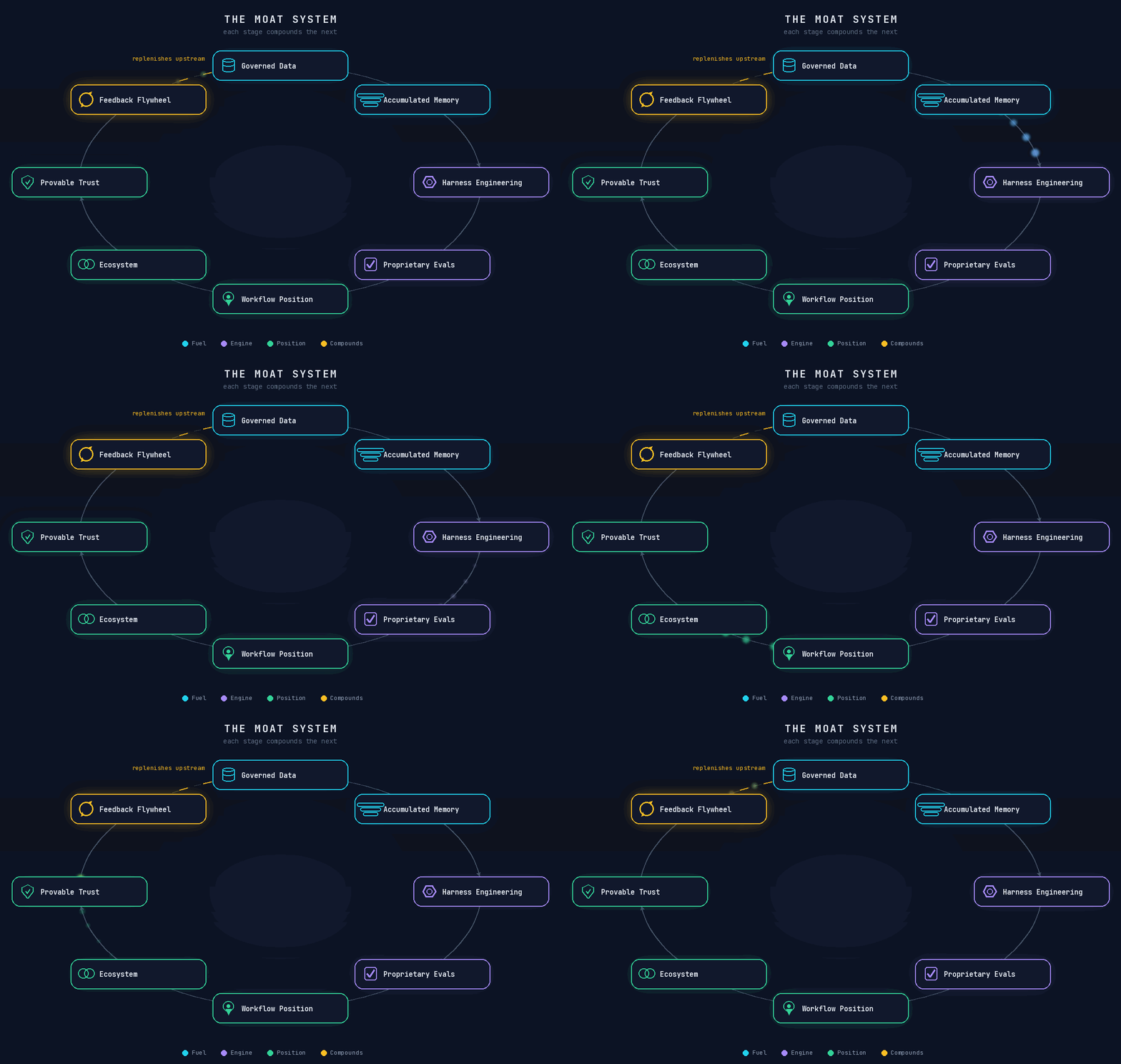
The moat system: eight differentiators arranged as a compounding chain governed data feeds memory, memory powers the harness, the harness earns position, position spins the flywheel, the flywheel replenishes the assets. Runtime governance is the foundation every stage stands on.
Proprietary data is the AI moat, but ungoverned data is a moat you can’t deploy. You can’t feed it to agents you don’t trust with it, you can’t fine-tune on data whose lineage and rights you can’t prove, and you can’t sell AI into a regulated market on data you can’t audit. Real governance is a pipeline: take a high-level policy, break it into machine-readable rules, and enforce those rules at runtime across every system that touches the data. That last step was always the whole game; what changed is the prize.
Summary
- Model is not the moat. LLMs are commoditizing toward open weights on your own infra; when every competitor has the same intelligence per token, intelligence stops differentiating.
- Eight moats, four families, one chain: what you have (governed data, accumulated memory), what you build (harness engineering, proprietary evals), where you sit (workflow surface, ecosystem, provable trust), and how it compounds (the feedback flywheel) every one needs runtime governance.
- Strategy follows the chain: fund the data foundation before the model, treat governance as product engineering, build evals early, keep the model a swappable part, win a surface and open it, and instrument the flywheel from day one.
- Governance has two inputs you must capture: metadata (what data you have, where it came from, who owns it) and policies (what’s allowed).
- Turn policies into rules. Break each policy into clear, machine-readable rules with explicit parameters (data types, access levels, roles)
if-thenlogic a system can execute. - A policy nobody enforces is theater. The value is in translating policy → rules → runtime enforcement, not in writing the policy.
- Enforce at runtime, everywhere the data flows data pipelines, access controls (RBAC/ABAC), application logic with monitoring to catch violations live.
1. Why Data Governance dies as a Document
Enterprise data governance is the framework of policies and controls that keep data managed, protected, and used responsibly quality, security, privacy, compliance, lifecycle, metadata. All of that is necessary. But it’s usually expressed as prose: “sensitive data must be masked,” “PII must not leave the EU,” “retain financial records for seven years.” Prose is for humans, and humans aren’t in the loop when a pipeline copies a table at 3 a.m. or an AI agent queries a dataset.
So the governance that works is the governance that’s been operationalized translated into something the systems themselves apply, with no human reading the policy at the moment of truth. The framing that follows: governance is a translation problem. You start with policy on the left (human language) and you need to arrive at enforcement on the right (machine behavior). Everything valuable happens in that translation, and most organizations never make the trip they stop at the well-written document and wonder why nothing changed.
2. Capture the two inputs: Metadata and Policies
Before you can enforce anything, you need to know what data you have and what the rules are.
Metadata data about your data. You can’t govern what you can’t see, so capture metadata (definitions, sources, lineage, ownership, usage) through three complementary methods:
- Automated discovery scanners profile your sources to extract types, columns, relationships, and statistics at scale (validated by humans).
- Manual entry data stewards add the context tools can’t infer (business meaning, ownership).
- AI-assisted NLP and ML models mine unstructured sources and generate descriptions/classifications fast, but it must be validated, because a confidently-wrong classification of sensitive data is worse than none.
Policies → rules. This is the translation that makes governance executable:
---
config:
theme: dark
fontSize: 17
themeVariables:
fontFamily: "Comic Sans MS, Comic Neue, Chalkboard SE, cursive"
---
flowchart LR
P[" Policy<br/>'mask sensitive data'<br/>(human language)"]:::neutral --> A["🔍 Analyze<br/>scope & intent"]:::obs
A --> R[" Extract<br/>if-then rules"]:::gate
R --> PA[" Parameterize<br/>data types · roles · levels"]:::server
PA --> F[" Executable rule<br/>write once ·<br/>deploy everywhere"]:::good
classDef neutral fill:#ECECEC,stroke:#8A8A8A,stroke-width:2px,color:#0F172A
classDef obs fill:#AED6F1,stroke:#2E86C1,stroke-width:2px,color:#0F172A
classDef gate fill:#D7C3F2,stroke:#8E5BD0,stroke-width:2px,color:#0F172A
classDef server fill:#A8E6D0,stroke:#2FA37C,stroke-width:2px,color:#0F172A
classDef good fill:#BFEFC8,stroke:#3FA34D,stroke-width:2px,color:#0F172A
Figure 2: The governance compiler policy goes in as human language and comes out as an executable rule, written once and deployed to every system that touches the data.
The steps: analyze each policy’s intent and scope; extract specific, unambiguous rules (what’s allowed, prohibited, required); define parameters that drive them (data classifications, access levels, user roles, configs); then formalize them in a standard, machine-readable syntax (if-then, logical expressions, a rule language) and validate against the original policy and edge cases. Build them modular and reusable so the same rule can be deployed across many systems a rule written once and enforced in ten places beats ten hand-coded variants that drift.
3. Enforce at Runtime, everywhere the data flows
A rule that lives only in a catalog is still a document. Enforcement means embedding it at every point data actually moves:
---
config:
theme: dark
fontSize: 17
themeVariables:
fontFamily: "Comic Sans MS, Comic Neue, Chalkboard SE, cursive"
---
flowchart TD
RULES["⚙️ Formalized rules"]:::gov --> PIPE["🌊 Data pipelines<br/>validate · transform<br/> · mask"]:::server
RULES --> AC[" Access control<br/>RBAC / ABAC,<br/> fine-grained"]:::gate
RULES --> APP[" Application logic<br/>encryption, masking,<br/> validation"]:::obs
RULES --> AGT[" Agent & MCP tool-call<br/>permission checked / call"]:::danger
RULES --> MON[" Runtime monitoring<br/>violations & alerts,<br/> live"]:::warn
classDef gov fill:#E0D6F5,stroke:#9B7EDE,stroke-width:2px,color:#0F172A
classDef server fill:#A8E6D0,stroke:#2FA37C,stroke-width:2px,color:#0F172A
classDef gate fill:#D7C3F2,stroke:#8E5BD0,stroke-width:2px,color:#0F172A
classDef obs fill:#AED6F1,stroke:#2E86C1,stroke-width:2px,color:#0F172A
classDef danger fill:#FFB3B3,stroke:#D14545,stroke-width:2px,color:#0F172A
classDef warn fill:#FFE6A8,stroke:#E0A106,stroke-width:2px,color:#0F172A
Figure 3: One rule set, every runtime touchpoint pipelines, access control, applications, live monitoring, and the newest and hungriest consumer: agent tool-calls, permission-checked per call.
- Data pipelines embed validation, transformation, masking, and cleansing rules directly into processing (Dataflow/Beam, NiFi, Kafka). Bad or non-compliant data gets caught as it flows, not in an after-the-fact audit.
- Access controls enforce who can see what with RBAC (by role) or ABAC (by attributes like data sensitivity + user context), at fine granularity, at query time.
- Application logic apply encryption, masking, and validation in services via shared libraries/middleware so enforcement is consistent across components.
- Runtime monitoring log enforcement events and violations in real time, with dashboards and alerts, so a breach is caught live rather than discovered in next quarter’s audit.
- Policy engines & CI/CD gates centralize enforcement with a policy engine that evaluates rules dynamically against runtime context, and add policy gates to your pipelines so violations are blocked before they reach production.
Why AI makes this non-optional now: an AI agent or model can read, join, and move data across systems in seconds, with no human pausing to consult the governance binder. If your rules aren’t enforced in the systems the AI touches the pipelines, the access layer, the APIs then for all practical purposes you have no governance over your most active new data consumer. Runtime-enforced governance is what lets you adopt AI without losing control of the data feeding it.
4. MODEL is NOT the Moat
Here’s the strategic backdrop that turns the plumbing above into board-level material. Large language models are commoditizing, on schedule and in public. Open-weight models trail the frontier by months, not years; inference cost per token has been falling roughly an order of magnitude a year; and every serious enterprise is already planning the same endgame capable open models running on their own infrastructure, for cost, privacy, and control. Play that forward five years and every competitor in your market has access to approximately the same intelligence per token.
When an input becomes uniformly available, it stops being a differentiator that’s not a prediction, it’s the definition of a commodity. Nobody wins their market today by “having cloud” or “having a database”; Postgres is free and identical for everyone, and yet data-driven businesses thrive because the schema, the data, and the systems built around the commodity were never the commodity. The same migration of value is happening in AI, and it’s moving to the two things a rival cannot download:
---
config:
theme: dark
fontSize: 17
themeVariables:
fontFamily: "Comic Sans MS, Comic Neue, Chalkboard SE, cursive"
---
flowchart TD
subgraph YOURS["🏰 THE MOATs - Above the commodity buildable only by you"]
PROD["🏆 Product & workflow<br/>where customers feel <br/>the difference"]:::good
EVAL["⚖️ Proprietary evals<br/>your definition of 'good'"]:::gate
HARN["🛠️ Harness engineering<br/>retrieval · tools · <br/>guardrails ·memory <br/>·orchestration"]:::server
GOVD["🛡️ Runtime-governed<br/>proprietary data<br/>discoverable · trusted <br/>permissioned <br/> lineage-tracked"]:::gov
PROD --> EVAL --> HARN --> GOVD
end
subgraph SAME["⚙️ Below the line same for everyone"]
LLM["🤖 Commodity LLM layer<br/>open weights <br/> falling cost / token <br/> swappable"]:::neutral
end
GOVD --> LLM
classDef good fill:#BFEFC8,stroke:#3FA34D,stroke-width:2px,color:#0F172A
classDef gate fill:#D7C3F2,stroke:#8E5BD0,stroke-width:2px,color:#0F172A
classDef server fill:#A8E6D0,stroke:#2FA37C,stroke-width:2px,color:#0F172A
classDef gov fill:#E0D6F5,stroke:#9B7EDE,stroke-width:2px,color:#0F172A
classDef neutral fill:#ECECEC,stroke:#8A8A8A,stroke-width:2px,color:#0F172A
Figure 4: The commodity. Everything below it converges for every competitor; everything above it is yours to build and the whole upper stack stands on governed data.
5. The Moat Map: 8 Differentiators in 4 Families
So what exactly is defensible when intelligence is a commodity? Eight moats and they’re not a list, they’re a chain. They fall into four families, and the order matters: what you have only matters through what you build; what you build earns where you sit; where you sit determines what compounds.
Moat 1 -> Governed Proprietary Data (Fuel) Note the adjective. Every company has data exhaust; The difference between exhaust and fuel is precisely the runtime pipeline. volume of data is not a moat deployability of data is. RAG over an ungoverned lake gives you confident garbage plus leaked PII, at machine speed; fine-tuning on rights-unclear data gives you a model you can’t ship.
Moat 2 -> Accumulated Context & Memory (Learn) Every session, your system learns the customer: their vocabulary, their exceptions, their approval chains, the way their edge cases differ from everyone else’s accumulated as agent memory, embeddings, and knowledge graphs. Six months in, your product completes their sentences; a competitor’s product, even on a better model, is a stranger who has to be taught everything again. That’s the classic switching-cost moat rebuilt for agents, and note how it differs from moat #1: proprietary data defends against competitors; accumulated memory defends against churn. One wins the market, the other keeps each customer.
Moat 3 -> Harness Engineering (Engine) The harness is the deterministic scaffolding around the nondeterministic core: retrieval pipelines, tool and MCP integrations into your systems, guardrails, memory, multi-agent orchestration, observability. It’s where your business logic, your workflows, and your edge cases live encoded as software you own, wrapped around a model you merely run. Two properties make it a moat.
- it’s cumulative: every incident handled, every edge case caught, every domain-specific tool built makes the harness harder to replicate it’s years of operational learning compiled into code.
- it’s inseparable from your data: a harness is largely the machinery that connects governed data to model power retrieval tuned to your corpus, permissions enforced per query, context assembled from systems only you have. A competitor with the same model and no harness has a chatbot. You have a product.
4. Proprietary Evals (AutoPilot) An eval suite is your codified definition of what good means in your domain the thousand judgment calls, failure cases, and regulatory edge conditions that only operating in your market teaches you. Competitors can benchmark on public leaderboards; they cannot download your judgment corpus. And evals carry a strategic bonus: they’re what make you model-agnostic. With a strong eval harness, swapping to next quarter’s cheaper open model is an afternoon of regression testing instead of a leap of faith which means evals are simultaneously your insurance against commoditization and your leverage from it. You get to ride the cost curve down on auto pilot while model-locked competitors watch.
Moat 5 -> Workflow Position (Surface) Agents create value at the point of action, so the company that owns the surface where work actually happens the IDE, the claims queue, the dispatch board, the trading desk owns both the right to act and the right to observe. This is distribution, upgraded: in the AI era, workflow position isn’t just where you sell, it’s where interaction data is born. Whoever owns the surface captures the corrections, the approvals, the edge cases which means whoever owns the surface is the only one who gets to spin the flywheel (moat #8). Everyone else integrates through a keyhole.
Moat 6 -> Ecosystem (Momentum) Once you own a surface, open it: let third parties ship tools, integrations, and MCP servers against your platform. Every external capability makes your product more complete without your headcount, and makes leaving costlier for customers who now depend on the extensions too a network effect on capabilities rather than users.
Moat 7 -> Provable Trust (Telemetry). If you operate where compliance is table stakes finance, healthcare, critical infrastructure the runtime enforcement logs from section 3 quietly become a sales asset. “We can show you every rule that fired on every query your data was part of” is a sentence that closes enterprise deals, because your buyer has to answer to their own regulator. Competitors bolting governance on after the fact can’t say it. Trust, evidenced at runtime, is a differentiator disguised as overhead and in regulated markets it decides whether you’re allowed to compete at all.
Moat 8 -> Feedback Flywheel (F2) A snapshot of any moat above depreciates; the loop appreciates. Production usage generates interaction data what users asked, what the agent retrieved, what worked, what got corrected. Governed and captured, that stream continuously improves retrieval, feeds fine-tuning, grows the eval suite, and deepens per-customer memory which improves the product, which wins more surface, which generates more usage. The flywheel is what turns the other seven moats from positions into trajectories, and it has a brutal property for late entrants: it can’t be bought, only accrued.
The chain, end to end: governance makes your data and memory deployable; harness and evals turn deployable assets into product behavior; product behavior wins the surface, the ecosystem, and the trust to sell; and the surface feeds the flywheel that replenishes everything upstream. Break any link and every moat downstream of it never forms.
---
config:
  theme: dark
  fontSize: 17
  themeVariables:
    fontFamily: "Comic Sans MS, Comic Neue, Chalkboard SE, cursive"
---
flowchart LR
    BASE[" Runtime governance<br/>(sections 1–3)<br/>the foundation"]:::gov
    BASE --> HAVE[" What you HAVE<br/>1 · governed data<br/>2 · accumulated memory"]:::server
    HAVE --> BUILD[" What you BUILD<br/>3 · harness engineering<br/>4 · proprietary evals"]:::obs
    BUILD --> SIT[" Where you SIT<br/>5 · workflow surface<br/>6 · ecosystem <br/> 7 · provable trust"]:::gate
    SIT --> GROW[" How it COMPOUNDS<br/>8 · feedback flywheel"]:::warn
    GROW --> MOAT[" Durable AI moat<br/>can't be downloaded <br/>·can't be bought <br/>· only built"]:::moat
    GROW -.->|"replenishes"| HAVE
    classDef gov fill:#E0D6F5,stroke:#9B7EDE,stroke-width:2px,color:#0F172A
    classDef server fill:#A8E6D0,stroke:#2FA37C,stroke-width:2px,color:#0F172A
    classDef obs fill:#AED6F1,stroke:#2E86C1,stroke-width:2px,color:#0F172A
    classDef gate fill:#D7C3F2,stroke:#8E5BD0,stroke-width:2px,color:#0F172A
    classDef warn fill:#FFE6A8,stroke:#E0A106,stroke-width:2px,color:#0F172A
    classDef moat fill:#BFEFC8,stroke:#3FA34D,stroke-width:3px,color:#0F172A
Figure 5: The moat map as a chain assets feed engineering, engineering earns position, position spins the flywheel, and the flywheel replenishes the assets. Governance is the foundation every link stands on; break one link and everything downstream never forms.
| # | Family | Moat | Why a competitor can’t copy it | What it needs from governance |
|---|---|---|---|---|
| 1 | Have | Governed data | They don’t have your data and can’t make theirs deployable overnight | It is governance (sections 1–3) |
| 2 | Have | Accumulated memory | Months of per-customer context can’t be imported; a rival starts as a stranger | Retention rules, deletion rights, access boundaries on the most PII-dense asset you hold |
| 3 | Build | Harness engineering | Years of domain logic and operational learning, compiled into code | Enforced access + trusted metadata at every tool call |
| 4 | Build | Proprietary evals | Judgment can’t be downloaded; it’s earned in production | Governed test data; violations become eval cases |
| 5 | Sit | Workflow surface | Being where work happens is won slowly and defended daily | Trust to be allowed on the surface at all |
| 6 | Sit | Ecosystem | Third-party investment compounds around the platform, not the copycat | A runtime permission model strong enough to admit untrusted tools |
| 7 | Sit | Provable trust | Can’t be retrofitted credibly; regulators and buyers know the difference | The enforcement logs, verbatim |
| 8 | Compound | Feedback flywheel | Compounds with time and traffic; can’t be bought, only accrued | Safe capture of interaction data |
6. The strategy: build the refinery before you worship the engine
If the analysis above is right, it inverts the default AI budget. Most companies are spending like the model is the asset model access, prompt experiments, pilot theater while the actual assets go unfunded. Dollars into model access are rent paid on a depreciating commodity; dollars into governed data, harness, and evals are equity in an appreciating one. The playbook that follows:
- Fund the data foundation before the model bill. A mediocre model over well-governed data beats a frontier model over a swamp and the gap widens as models converge, because the model was the only part of that comparison that stops mattering.
- Move governance from the compliance org to product engineering. A policy team produces documents; a platform team produces enforcement. The deliverable is rules running in pipelines, access layers, and agent tool-calls staffed and roadmapped like any other product infrastructure.
- Build the eval harness embarrassingly early. Before scale, before the second use case. Every production failure becomes a permanent test case; every test case is judgment your competitor doesn’t have. Evals are also your exit option from any model vendor negotiating leverage you buy once and keep.
- Design the harness so the model is a swappable part. Hide the model behind an interface, route by task, re-certify with evals on every swap. The companies that win commoditization are the ones positioned to consume it.
- Pick a surface and win it then open it. Choose the workflow where your agents act, own it deeply enough that interaction data is born inside your product, and expose a permissioned tool interface so third parties extend it. Position and ecosystem are decided early and reversed rarely.
- Accumulate memory deliberately, under rules. Per-customer context is your churn defense, but only if retention, deletion, and access boundaries are enforced at runtime from the start retrofitting governance onto a memory store is how switching costs become breach headlines.
- Instrument the flywheel from day one. Capture interactions, corrections, and outcomes under the same runtime rules as everything else and feed them back into retrieval, fine-tuning, evals, and memory. The moat isn’t the data you have; it’s the rate at which usage makes your data better.
The moat system: eight differentiators arranged as a compounding chain governed data feeds memory, memory powers the harness, the harness earns position, position spins the flywheel, the flywheel replenishes the assets. Runtime governance is the foundation every stage stands on.
References
- DAMA-DMBOK the data management body of knowledge (governance framework)
- Open Policy Agent policy-as-code for runtime, machine-readable enforcement
- Google Cloud Dataplex · Collibra metadata management and governance platforms
- NIST AI Risk Management Framework governing data in AI systems
- The New Moats (Jerry Chen, Greylock) the systems-of-intelligence argument this article’s flywheel builds on