Why I Stopped 'Prompting' and Started 'Architecting' Intent The TACORE Framework

Dean Jain
Senior Staff Software Engineer · Enterprise AI, Data & Cloud Architect
· 3 min read
After reviewing hundreds of AI-generated artifacts across teams this year, I noticed something uncomfortable:
Most people are still rolling the dice with LLMs.
They type a question. They hope. They iterate 4–5 times. They paste the result into a doc and call it a day.
That’s not engineering. That’s gambling with extra steps.
In 2026, the differentiator isn’t which model you use, it’s the Intent Architecture you bring to it. So I want to share the framework I use to design high-stakes prompts!
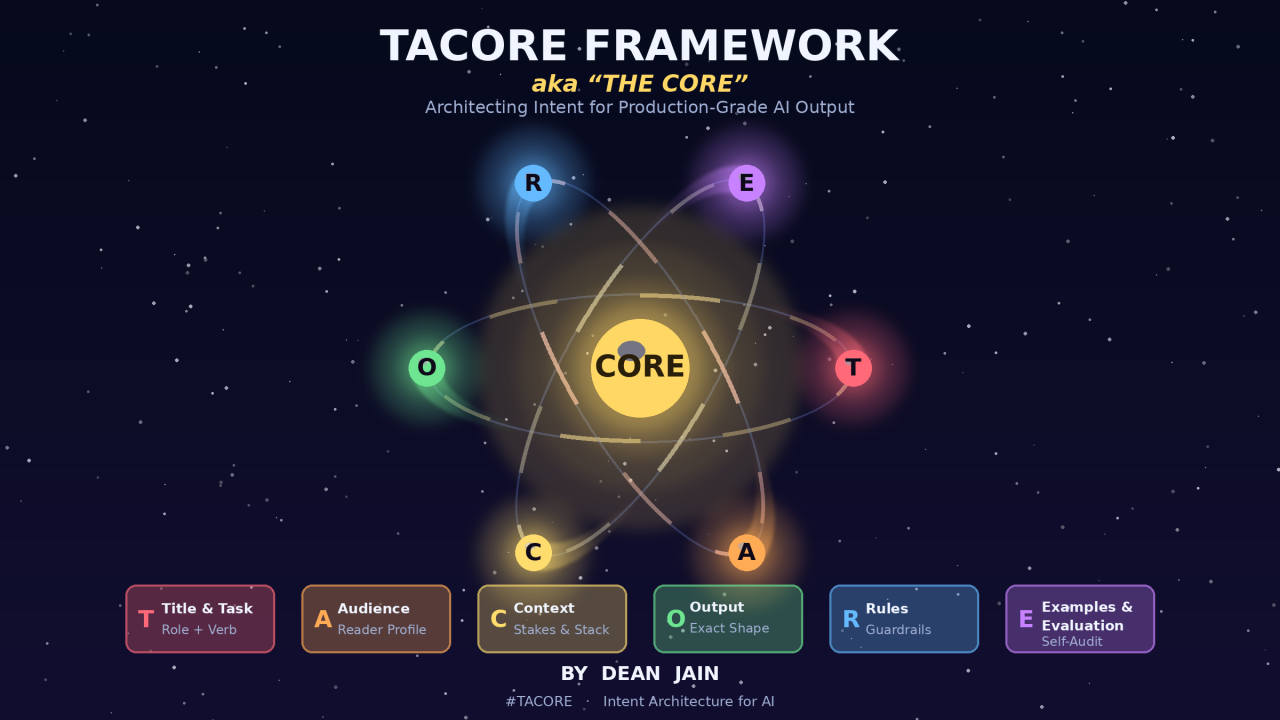
TACORE ⚛ Framework - pronounced as ‘The CORE’ ⚛
Six components. Non-negotiable. Treat them like required fields in a JSON schema.
- T Title and Task → Assign the AI a role and a verb. “Act as a Principal Cloud Architect and Critically review…”
- A Audience → Who reads this? A CTO needs different signal than a junior dev. Tone follows.
- C Context → The constraints, the stack, the stakes. “Mission-critical payments. Zero downtime tolerance.”
- O Output → The exact shape: scorecard, table, recommendation. No ambiguity.
- R Rules → Avoid generic AWS best practices. Require specifics, such as cold-start latency, DynamoDB throttling, autoscaling behavior, and IAM privilege escalation
- E Example & Evaluation → Show what “good” looks like, then define the evaluation bar. Tell the AI to check its own answer against that bar before responding.
The “E” is the part everyone skips. It’s also the part that changes everything.
🚀 TACORE in Action: A Real Architecture Review
Let’s compare two prompts I’ve actually seen this quarter.
❌ The Lazy Prompt
“Review this architecture for a legacy migration to AWS and tell me if there are any risks.”
Result: A wall of 10 generic bullet points. “Ensure security.” “Monitor costs.” “Use IAM properly.” Technically correct. Strategically useless. You can’t take that into a steering committee.
✅ The TACORE Prompt
- Task: Act as a Principal Cloud Architect and Security Red-Teamer and Critically review this serverless migration plan…
- Audience: Senior Director of Engineering and CTO. Decisive, technical, risk-oriented…
- Context: Mission-critical payment processing system. On-prem monolith migrate to AWS Lambda + DynamoDB. Downtime budget: 0%…
- Output: Risk Scorecard (1–10), 3-column table (Risk | Business Impact | Mitigation), Go/No-Go recommendation…
- Rules: No fluff. No generic AWS best practices. Focus only on cold-start latency, DynamoDB throttling, Autoscaling and IAM privilege escalation.
- Example/Eval: Self-check: does every mitigation directly address the 0% downtime constraint? If a mitigation is missing a specific AWS service name, flag it as “Incomplete.”
Result: A production-ready scorecard. Specific risks. Specific services. Specific mitigations.
💡 Why TACORE Works (The Strategic Layer)
This isn’t about prettier prompts. It’s about how technical leaders should think about LLMs as systems.
- 🎯 Deterministic Outcome Defining Rules ‘R’ moves you from “rolling the dice” to predictable, production-ready outcomes.
- 💸 The Iteration Tax Refund Most engineers spend 80% of their AI time fixing bad outputs. TACORE inverts that: invest in the prompt, get a much stronger first draft that needs less rework.
- ✅ Built-in QA The E (“Evaluation”) is the only piece of any prompt framework with a “Definition of Done” baked in. The AI audits itself before you ever see the answer.
- 🧱 Scalable Intent Architecture TACORE prompts are reusable like code. Hand one to a teammate or a multi-agent swarm the intent survives the handoff. It can also help teams build an org-wide prompt library around a common standard.
- 🛡️ Hallucination-Resistant Guardrails The Rules section is a technical firewall. It prevents creative liberties on sensitive systems, regulated data, or professional standards.
🎯 The Takeaway
If your prompt doesn’t include explicit Rules and an Evaluation step, you aren’t directing the AI. You’re auditioning for it.
Also published on LinkedIn comments and prompt-library war stories welcome there.